
Music Theory
3 min
Irregular Musical Rhythms and Subdivisions
A tuplet divides a musical beat into an irregular number of subdivisions not normally dictated by the time signature.
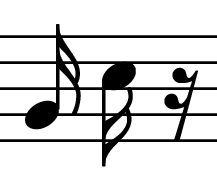
In music, a sixteenth note (known in British terminology as a semiquaver) is a musical note played for one-sixteenth of the duration of a whole note, or half the duration of an eighth note (quaver). Historically, it is the equivalent of the semifusa found in 15th-century mensural notation.
Sixteenth notes are graphically represented with an oval, filled-in note head and a straight stem featuring two flags. When multiple sixteenth notes appear consecutively, their flags are typically replaced by connecting horizontal beams.
A corresponding silence of the exact same duration is denoted by the sixteenth rest (or semiquaver rest). Stem direction and flag orientation follow standard music engraving rules depending on the note's vertical position on the staff.
The modern sixteenth note descends from the semifusa of mensural notation, which first appeared during the 15th century. In certain Romance languages such as Spanish, Catalan, and Portuguese, the historical term semifusa is alternatively used to designate the modern sixty-fourth note.
They are terms for the exact same musical note value; 'sixteenth note' is predominantly used in American terminology, while 'semiquaver' is standard in British terminology.
Morehen, John; Rastall, Richard (2001). "Semiquaver". In Sadie, Stanley; Tyrrell, John (eds.). The New Grove Dictionary of Music and Musicians (2nd ed.). London: Macmillan. ISBN 9780195170672.
Gerou, Tom (1996). Essential Dictionary of Music Notation. Alfred. p. 211. ISBN 9780882847306.
A tuplet divides a musical beat into an irregular number of subdivisions not normally dictated by the time signature.
Tremolo involves either the rapid repetition of a note, alternation between notes, or variation in volume.

Mulgrave is located 21 kilometres south-east of Melbourne's central business district.