Ornithology
2 min
The Biology and Taxonomy of Parulidae: New World Warblers
The family Parulidae consists of approximately 120 species of small passerine birds native to the Americas.
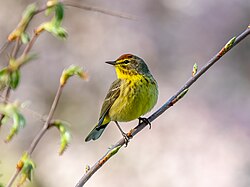
The palm warbler (Setophaga palmarum) is a distinctive species of New World warbler belonging to the family Parulidae. Known for its unique behavioral traits and extensive migratory range, this small songbird is a common sight across much of North America during its seasonal movements.
The species was formally described by Johann Friedrich Gmelin in 1789. It is divided into two primary subspecies that exhibit notable differences in plumage and migratory behavior:
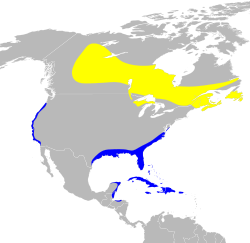
Palm warblers breed primarily in open coniferous bogs and forest edges across Canada and the northeastern United States. Unlike many other warblers, they are highly adaptable, utilizing shrublands, grasslands, and even human-modified environments. Their wintering grounds are extensive, stretching from the Atlantic coast of the United States through the Caribbean and into Central America as far south as Panama.
A defining characteristic of the palm warbler is its habit of incessantly bobbing its tail, a behavior shared with only a few other members of the Setophaga genus, such as the Kirtland's and prairie warblers. They are primarily ground-foragers, often seen walking on the forest floor or in open fields to hunt for insects, though they also consume berries.
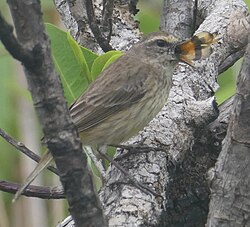
The species is known for being an early spring migrant, often arriving at breeding grounds significantly earlier than other warbler species. Their vocalizations consist of a monotonous, buzzy trill, accompanied by a sharp "chek" call.
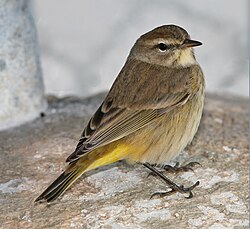
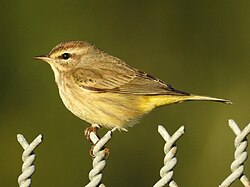
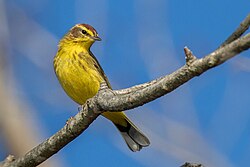
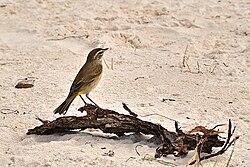
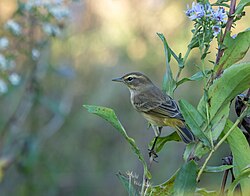
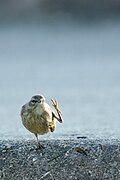
Despite the name, the bird is not exclusively associated with palm trees. The name likely stems from early observations of the species in wintering grounds where palm trees are prevalent, such as the Caribbean and Florida.
Wilson, Alexander (1810). American Ornithology. Vol. 2. pp. 111–112.
"Palm Warbler Sounds, All About Birds, Cornell Lab of Ornithology". Archived from the original on 2023-10-01. Retrieved 2023-10-08.
"Palm Warbler | Audubon Field Guide". Audubon. National Audubon Society. Archived from the original on 2025-01-24. Retrieved 2025-03-09.
Gmelin, Johann F. (1789). Systema Naturae per Regna Tria Naturae, Secundum Classes, Ordines, Genera, Species, cum Characteribus, Differentiis, Synonymis, Locis. Vol. 1 (13 ed.). p. 951.
"Palm Warbler | Audubon Field Guide". www.audubon.org. Archived from the original on 2023-10-02. Retrieved 2023-12-26.
"New World warblers, mitrospingid tanagers – IOC World Bird List". IOC World Bird List – Version 14.2. 2025-02-20. Archived from the original on 2026-01-10. Retrieved 2025-11-20.
"Palm warbler Dendroica palmarum". Patuxent Wildlife Research Center. Archived from the original on 2017-03-01. Retrieved 2017-03-01.
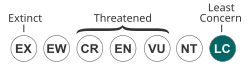
BirdLife International (2021). "Setophaga palmarum". IUCN Red List of Threatened Species. 2021 e.T22721731A138795720. doi:10.2305/IUCN.UK.2021-3.RLTS.T22721731A138795720.en.
Yoo, Gihyun; Weir, Jason T. (2025). "Population Divergence in the Eastern North American Boreal Forests: Extensive Gene Flow Characterises a Hybrid Zone Between Palm Warbler Subspecies (Parulidae: Setophaga palmarum )". Molecular Ecology. 34 (16) e70032. Bibcode:2025MolEc..3470032Y. doi:10.1111/mec.70032. ISSN 0962-1083. PMC 12329643. PMID 40678896.
"Palm Warbler Identification, All About Birds, Cornell Lab of Ornithology". www.allaboutbirds.org. Archived from the original on 2020-09-29. Retrieved 2020-09-30.
The family Parulidae consists of approximately 120 species of small passerine birds native to the Americas.
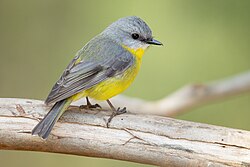
Songbirds belong to the suborder Passeri, which contains approximately 4,000 species.
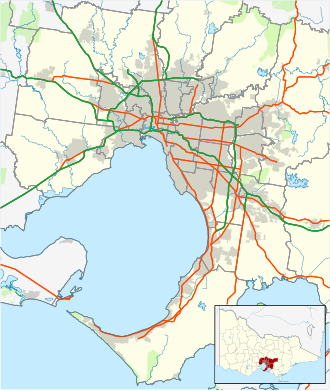
Mulgrave is located 21 kilometres south-east of Melbourne's central business district.