Ornithology
2 min
The Biology and Taxonomy of Parulidae: New World Warblers
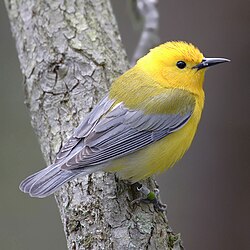
The family Parulidae consists of approximately 120 species of small passerine birds native to the Americas.
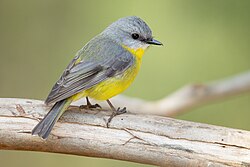
Songbirds, scientifically classified within the suborder Passeri (also known as Oscines), represent the most diverse group of perching birds. Comprising approximately 4,000 species, they constitute one of the two primary lineages of the order Passeriformes, the other being the Tyranni. While the Tyranni are often characterized by more mechanical-sounding vocalizations, the Passeri are distinguished by their highly developed vocal organ, the syrinx.
Recent scientific consensus suggests that songbirds originated approximately 50 million years ago during the Eocene epoch. Evidence from the distribution of basal lineages indicates that their initial diversification occurred exclusively on the Australian continent. It was not until roughly 40 million years ago that these birds began to expand their range, eventually colonizing Eurasia, Africa, and the Americas.
The defining characteristic of the songbird is the syrinx, a complex bony structure located at the base of the trachea where it diverges into the bronchial tubes. This organ allows for the production of intricate, melodious songs. Contrary to popular belief, the size and complexity of the syrinx do not solely dictate a bird's vocal range; the length of the windpipe also plays a significant role in determining the quality and variety of the song.
While many songbirds are known for their musical abilities, the term "songbird" refers to the biological classification rather than the aesthetic quality of the sound. Members of the Corvidae family, for instance, often produce harsh croaks or screeches, yet they still possess the anatomical structures characteristic of the suborder.
Vocalization in songbirds is primarily a territorial and reproductive behavior. Males use their song repertoires to signal their identity, defend territory, and attract mates. Research into sexual selection has highlighted a complex relationship between song repertoire size and reproductive success. Interestingly, studies suggest an evolutionary trade-off between cognitive abilities, such as spatial learning, and the complexity of a male's song repertoire, indicating that natural selection favors different traits depending on the environmental pressures faced by the species.
No. While the group is named for its vocal capabilities, many species, such as those in the crow family, produce sounds that are harsh or repetitive rather than what humans typically consider musical.
Chris Cooney, "How songbirds island-hopped their way from Australia to colonise the world", The Conversation, August 31, 2016.
Byers, Bruce E; Kroodsma, Donald E (2009). "Female mate choice and songbird song repertoires". Animal Behaviour. 77 (1): 13–22. Bibcode:2009AnBeh..77...13B. doi:10.1016/j.anbehav.2008.10.003. S2CID 53146576.
Fleming, Kaitlin (11 December 2011). "The Northern Mockingbird: Nature's Copycat". FSU ornithology: the bird blogs. Retrieved 18 June 2018.
Lowi-Merri, Talia M.; Gjevori, Martina; Bochenski, Zbigniew M.; Wertz, Krzysztof; Claramunt, Santiago (2024-12-31). "Total-evidence dating and the phylogenetic affinities of early fossil passerines". Journal of Systematic Palaeontology. 22 (1) 2356086. Bibcode:2024JSPal..2256086L. doi:10.1080/14772019.2024.2356086. ISSN 1477-2019.
Reilly, John (2018). The Ascent of Birds. Pelagic Publishing. p. 182. ISBN 978-1-78427-203-6.
Low, T. (2014), Where Song Began: Australia's Birds and How They Changed the World, Tyre: Penguin Australia
Sewall, K. B; Soha, J. A; Peters, S; Nowicki, S (2013). "Potential trade-off between vocal ornamentation and spatial ability in a songbird". Biology Letters. 9 (4) 20130344. doi:10.1098/rsbl.2013.0344. PMC 3730647. PMID 23697642.
Claramunt, S.; Cracraft, J. (2015). "A new time tree reveals Earth history's imprint on the evolution of modern birds". Science Advances. 1 (11) e1501005. Bibcode:2015SciA....1E1005C. doi:10.1126/sciadv.1501005. PMC 4730849. PMID 26824065.
Harshman, John. (2006). Oscines. Songbirds. Version 31 July 2006 (under construction). http://tolweb.org/Oscines/29222/2006.07.31 Archived 2020-09-19 at the Wayback Machine in The Tree of Life Web Project, http://tolweb.org/
IOC World Bird List 5.1. doi:10.14344/IOC.ML.5.1.
The family Parulidae consists of approximately 120 species of small passerine birds native to the Americas.
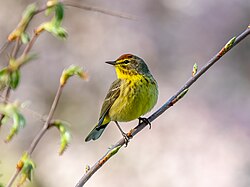
The palm warbler is one of the few warbler species that constantly bobs its tail.
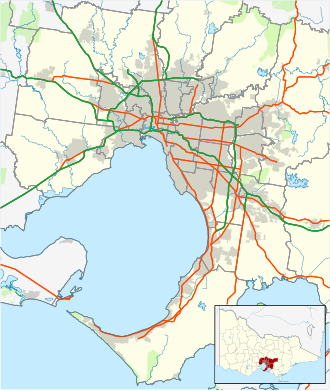
Mulgrave is located 21 kilometres south-east of Melbourne's central business district.