Geography
2 min
Pietroasele
Pietroasele is located in Buzău County, Romania, and consists of six villages.
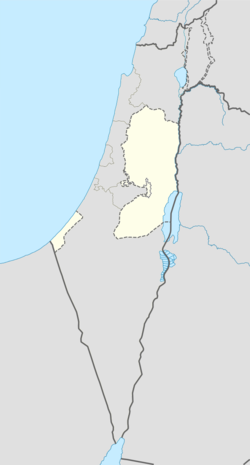
Zibda (Arabic: زبده) is a small Palestinian village located in the Jenin Governorate in the northern part of the West Bank. Dominated historically and socially by the Amarnah family from nearby Ya'bad, the village possesses a rich archaeological and administrative history spanning multiple empires and eras.
Archaeological surveys of Zibda have uncovered pottery sherds indicating long-term human habitation and agricultural use. Findings include fragments from the early and late Roman eras, the Byzantine era, early Muslim periods, and the Middle Ages. In Crusader sources around the year 1200, a location named Zebedellum is noted, which historians consider is likely Zibda.
Following the incorporation of Palestine into the Ottoman Empire in 1517, Zibda—then part of the Turabay Emirate—was documented in administrative tax records. In the Ottoman census of 1596, the village appeared under the name Zabda, situated in the nahiya of Sha'ara within the liwa of Lajjun. At that time, it was home to 26 Muslim households who paid a fixed tax rate on agricultural yields such as wheat, barley, summer crops, goats, and beehives, alongside revenues from an olive oil or grape syrup press.
Historical records indicate the village was temporarily abandoned following conflicts or blood feuds among local residents sometime after the 18th century, potentially during the Qays–Yaman conflicts of 1840–1860. By the 19th century, travellers and surveyors visited the area; the Palestine Exploration Fund's 1882 Survey of Western Palestine described Zebdah as a ruined village featuring a water well.
During the British Mandate period, the population of Zabdah was recorded as 150 Muslims in the 1922 census, dropping slightly to 132 Muslims across 22 houses in the 1931 census. Official land and population surveys in 1945 recorded 190 Muslim residents and a total land area of 11,924 dunams, of which a portion was utilized for plantations, irrigable agriculture, and cereal cultivation, while the majority was categorized as non-cultivable land.
Following the 1948 Arab–Israeli War and the 1949 Armistice Agreements, the village came under Jordanian administration. The Jordanian census of 1961 registered an increase in the population to 225 inhabitants.
Since the Six-Day War in 1967, Zibda has been under Israeli occupation. The village contains two historic tombs within its boundaries.
Zibda is a Palestinian village located in the Jenin Governorate in the northern West Bank.
Marom, Roy; Marom, Tepper; Adams, Matthew, J (2023). "Lajjun: Forgotten Provincial Capital in Ottoman Palestine". Levant. 55 (2): 218–241. doi:10.1080/00758914.2023.2202484. S2CID 258602184.
Conder and Kitchener, 1882, SWP II, p. 72
Barron, 1923, Table V, Sub-district of Jenin, p. 30
Preliminary Results of the Population, Housing and Establishments Census, 2017 (PDF). Palestinian Central Bureau of Statistics (PCBS) (Report). State of Palestine. February 2018. pp. 64–82. Retrieved 2023-10-24.
Palmer, 1881, p. 156
Zertal, 2016, pp. 288- 289
Frantzman and Bar, 2013, p. 102
Dauphin, 1998, p. 751
Hütteroth and Abdulfattah, 1977, p. 159
Government of Jordan, Department of Statistics, 1964, p. 25
Pietroasele is located in Buzău County, Romania, and consists of six villages.

Nanumanga is a reef island in Tuvalu with a land area of approximately 3 square kilometers.
Kinrooi was formed in 1971 by merging the municipalities of Kinrooi, Kessenich, Geistingen-Ophoven, and Molenbeersel.