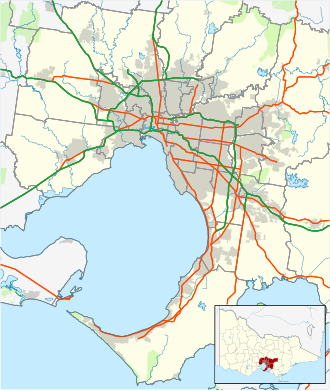
Geography
2 min
Mulgrave Suburb History and Geography
Mulgrave is located 21 kilometres south-east of Melbourne's central business district.
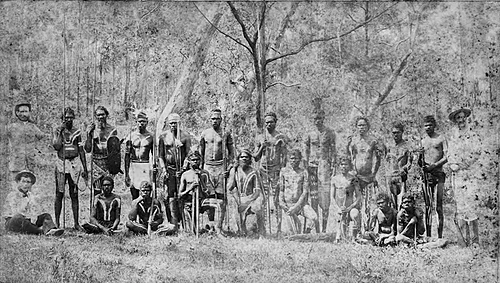
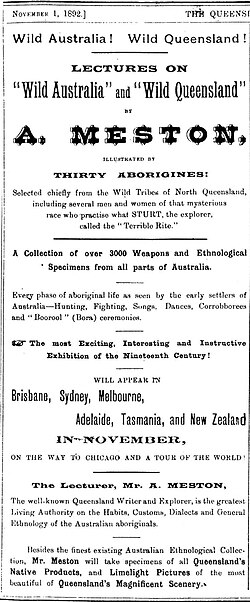
The Wild Australia Show was a touring performance troupe consisting of 27 Indigenous Australians from northern Queensland. Active during 1892 and 1893, the show was organized by Scottish-born journalist and politician Archibald Meston and his business partner, Brabazon Harry Purcell. The venture was designed to capitalize on the popularity of ethnological exhibitions and Wild West shows of the late 19th century, with the organizers originally intending to tour the troupe internationally, culminating in a performance at the 1893 World's Columbian Exposition in Chicago.
Archibald Meston, a former member of the Queensland Legislative Assembly, had previously held openly racist views before reinventing himself as an expert on Aboriginal culture. By 1890, he began presenting "illustrated lectures" in Brisbane that featured live Indigenous performers, taxidermied animals, and staged scenes of frontier life. These lectures served as the prototype for the Wild Australia Show. Meston and Purcell recruited the troupe between 1891 and 1892, selecting individuals based on physical fitness to align with Meston's curated image of Aboriginal athleticism.
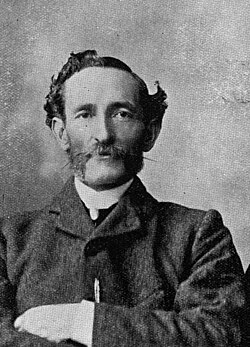
The troupe performed in major Australian cities, including Brisbane, Sydney, and Melbourne. The performances typically included traditional dances, corroborees, and demonstrations of weapon skills such as spear and boomerang throwing. Meston and Purcell provided commentary, framing the performances within the colonial lens of the era. The troupe was documented by prominent photographers of the time, including Charles Kerry and John William Lindt.
The venture faced significant financial instability and internal disputes between Meston and Purcell. In 1893, while in Melbourne, Meston abandoned the troupe, leaving the performers and Purcell stranded without the necessary funds to return to their homes in Queensland. The failure of the tour resulted in a public scandal, including accusations of kidnapping and exploitation. Following the collapse, the performers returned to their respective lands, and the troupe largely disappeared from the public record for decades until modern historical research began to reconstruct their experiences.
The show was intended to be a commercial enterprise showcasing Indigenous Australian culture through performances, similar to the popular Wild West shows of the late 19th century.
Nugent 2025, pp. 13–14.
Walker 2002, p. 136.
Nugent 2019, pp. 233–234.
McKay & Memmott 2016, p. 184.
Nugent 2019, p. 234.
Memmott 2025d, p. 95.
Richards 2025, pp. 35, 42.
Memmott 2025, p. 61.
Knowles et al. 2025, pp. 222–224.
Memmott 2025c, p. 82.
Mulgrave is located 21 kilometres south-east of Melbourne's central business district.
The violin octet consists of eight acoustically scaled bowed string instruments.
Goran Obradović was born on January 29, 1971.