Medieval History
2 min
History and Legacy of the Zagwe Dynasty
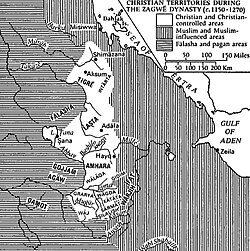
The Zagwe dynasty ruled parts of Ethiopia and Eritrea from approximately 1137 to 1270.
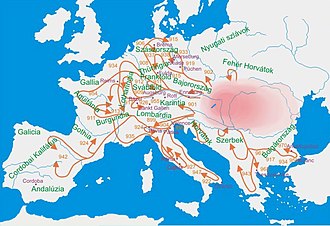
The military campaigns conducted by Hungarian tribes, commonly known as the Hungarian invasions of Europe, took place during the 9th and 10th centuries. This era of the Early Middle Ages was characterized by widespread transitions, during which former Carolingian territories faced multiple external pressures, including Magyar movements from the east, Viking expansions from the north, and Arab incursions from the south.
Between 862 and 895, the Hungarians undertook a structured settlement process culminating in the occupation of the Carpathian Basin. From this base, they launched strategic military operations extending westward into former Frankish territories and southward into the Byzantine Empire. Contemporary chroniclers and later historians documented numerous raids targeting kingdoms, principalities, and duchies across Western Europe, Eastern Europe, the Balkans, and the Iberian Peninsula.
Prior to their complete settlement in the Carpathian Basin, various Magyar groups participated in regional alliances and conflicts. Early records indicate Magyar forces cooperating with Bulgarian leaders against the Byzantine Empire in the early 9th century. Throughout the latter half of the 9th century, Muslim geographers and contemporary annalists noted conflicts and alliances involving East Francia, Great Moravia, and neighboring East Slavic populations.
Following their permanent entry into the Carpathian Basin around 896 under leaders such as Árpád, Hungarian forces executed numerous campaigns into northern Italy, East Francia, and Germanic lands. Western expansion was significantly curtailed following the defeat of Magyar forces at the Battle of Lechfeld in 955. Subsequent political consolidation and the eventual Christianization of the Hungarians led to the establishment of the Christian Kingdom of Hungary around the year 1000, bringing an end to the raiding period.
The campaigns occurred during the 9th and 10th centuries, generally dated between c. 800/839 and 970.
Szabados, György (August 2005). "Vereség háttér nélkül? Augsburg, 955" [Defeat without background? Augsburg, 955]. Hitel – irodalmi, művészeti és társadalmi folyóirat [literary, artistic and social journal] (in Hungarian) (8).
Csorba, Csaba (1997). Árpád népe (Árpád's people). Budapest: Kulturtrade. p. 193. ISBN 963-9069-20-5.
Baják László (2000). p. 20–21
Halmágyi, Miklós (2007). "A magyarok nyilaitól…" (PDF). Aetas (in Hungarian). 22 (3): 142–147. ab Ungerorum nos defendas iaculis
Baják László (2000). p. 15
Lajos Gubcsi, Hungary in the Carpathian Basin, MoD Zrínyi Media Ltd, 2011
Baják László (2000). p. 36
Stanley Sandler, Ground warfare: an international encyclopedia, Volume 1, Volume 1, ABC-CLIO, 2002, p. 527
Kristó Gyula: Levedi törzsszövetségétől Szent István Államáig; Magvető Könyvkiadó, Budapest, 1980, p. 282
Baják László (2000). p. 28–29
The Zagwe dynasty ruled parts of Ethiopia and Eritrea from approximately 1137 to 1270.
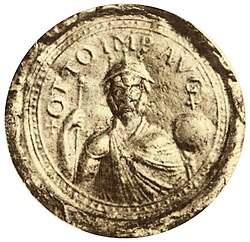
Otto I was born on November 23, 912, as the oldest son of Henry the Fowler.
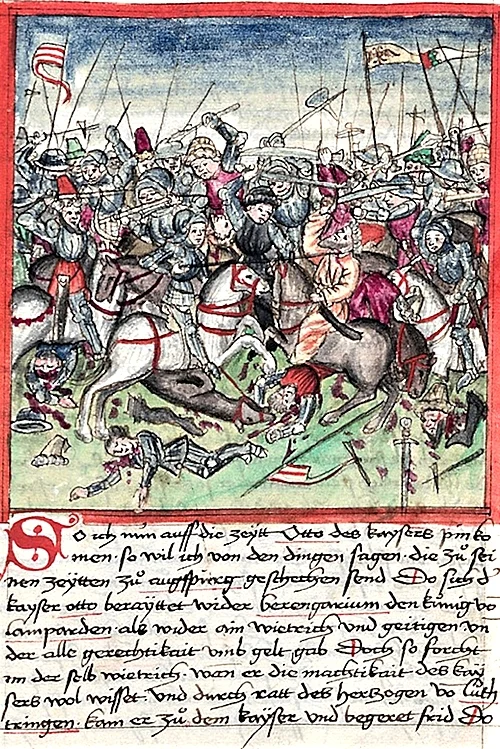
The year 955 was a common year starting on Monday of the Julian calendar.