Medieval History
2 min
Magyar Campaigns Across Medieval Europe
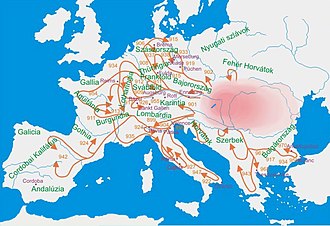
The campaigns primarily occurred during the 9th and 10th centuries, spanning from approximately 800 or 839 to 970.
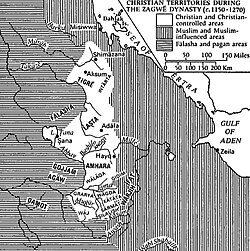
The Zagwe dynasty was a medieval kingdom that ruled over parts of modern-day Ethiopia and Eritrea. Emerging around the 12th century—with traditional chronology citing establishment around 1137—the dynasty succeeded the Kingdom of Aksum and maintained power until its overthrow in 1270 by the early Solomonic dynasty.
Administered primarily from its capital at Adefa, the dynasty operated as an absolute monarchy under the rule of the Negus (King). The ruling class was associated with the Agaw people, while the common languages spoken during this era included Agaw, Amharic, Ge'ez, and Tigrinya. The official state religion was Ethiopian Orthodox Tewahedo, which heavily influenced the political structures, architecture, and cultural production of the period.
The transition from the late Aksumite period to the consolidation of Zagwe rule involved complex regional shifts. Scholars note various historical theories regarding the exact timeline of the dynasty's rise, with some historiographical traditions suggesting origins extending back earlier into the 10th century. Prominent rulers of the dynasty included Mara Takla Haymanot, who initiated rule in the early 12th century, and Yetbarak, who ruled during the 13th century.
The dynasty faced a definitive end in 1270 at the Battle of Ansata, where forces associated with Yekuno Amlak defeated the final Zagwe monarch, paving the way for the establishment of the Ethiopian Empire.
The Zagwe dynasty traditionally ruled from 1137 until 1270.
Demeke, Girma A. (2014). The Origin of Amharic. The Red Sea Press. p. 53. ISBN 978-1-56902-379-2. OCLC 824502290.
Loiseau, Julien et al. (2021): "Bilet and the wider world: new insights into the archaeology of Islam in Tigray" Antiquity 95, 523–525
Taddesse Tamrat (1972). Church and State in Ethiopia. Oxford: Clarendon Press. pp. 53–64. ISBN 0-19-821671-8.
Marie-Laure Derat (2010): "The Zagwe dynasty (11–13th centuries) and King Yemrehanna Krestos", Annales d'Ethiopie, 25, p. 171
Mohammad Hassan, The Oromo of Ethiopia, p. 3
El-Antony, Fr. Maximous; Blid, Jesper (2016). "An Early Ethiopic Manuscript Fragment (Twelfth–Thirteenth Century) from the Monastery of St Antony (Egypt)", Aethiopica, 19, pp. 47–48
Chojnacki, Stanislaw (2005). "Wandgemäldem Ikonen, Manuskripte, Kreuze und anderes liturgisches Gerät". In Walter Raunig (ed.). Das christliche Äthiopien. Geschichte – Architektur – Kunst. Schnell & Steiner. pp. 236–237.
Bounga, Ayda (2014). The kingdom of Damot: An Inquiry into Political and Economic Power in the Horn of Africa (13th c.). Annales D'ethiopie. p. 262.
Edward Ullendorff, The Ethiopians, Oxford University Press, 1960
It has been proposed that they were under influence of the Dahlak Sultanate. The much later hagiography of St. Marqorewos, who lived around the year 1400, mentions a Muslim king in nearby Shire who might have lived during the reign of king Lalibela.
The campaigns primarily occurred during the 9th and 10th centuries, spanning from approximately 800 or 839 to 970.
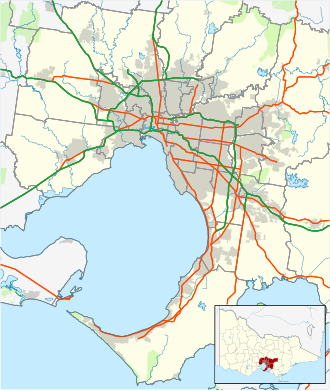
Mulgrave is located 21 kilometres south-east of Melbourne's central business district.
The violin octet consists of eight acoustically scaled bowed string instruments.