Geography
2 min
Mulgrave Suburb History and Geography
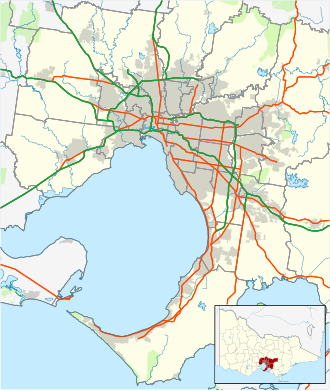
Mulgrave is located 21 kilometres south-east of Melbourne's central business district.
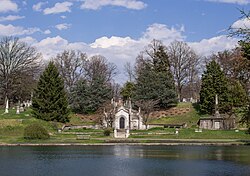
Green-Wood Cemetery, located in Brooklyn, New York, stands as one of the most significant examples of the 19th-century rural cemetery movement in the United States. Established in 1838, it was designed not merely as a final resting place, but as a landscaped retreat intended to provide solace and beauty for the living. Its development was spearheaded by Henry Evelyn Pierrepont, who sought to address the growing need for burial space in an rapidly urbanizing New York City and Brooklyn.
The cemetery's layout was crafted by landscape architect David Bates Douglass, who prioritized the preservation of the site's natural topography. Douglass rejected the idea of a formal necropolis, instead opting for a design that integrated winding roads and water features, such as Sylvan Water and Arbor Water, to create a park-like atmosphere. The cemetery was incorporated as a non-profit organization in 1839, and the first interment occurred in 1840. By the mid-19th century, it had become a major destination for visitors, often drawing crowds comparable to those at Niagara Falls.
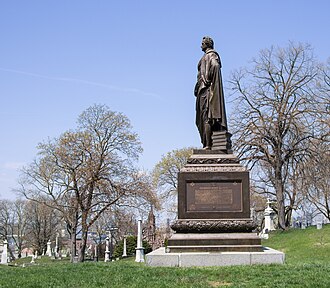
Throughout the 19th century, Green-Wood underwent several expansions, growing from its original 175 acres to approximately 440 acres by 1874. The site became a prestigious location for burial, housing the remains of prominent figures such as DeWitt Clinton, whose monument was erected in 1853. The cemetery's popularity was further bolstered by improved transportation infrastructure, including the Fifth Avenue Elevated station, which provided direct access to the main entrance. The surrounding area eventually developed a unique ecosystem of florists and monument sellers, such as the historic Weir Greenhouse, to support the needs of the cemetery and its visitors.
The rural cemetery movement was a 19th-century trend in urban planning that moved burial grounds from cramped, unsanitary churchyards in city centers to large, landscaped, park-like settings on the outskirts of cities.
Simmons, Jeff (May 22, 2025). "The Green-Wood Cemetery Names Meera Joshi as President". Brooklyn, NY Patch. Retrieved May 24, 2025.
White, Norval; Willensky, Elliot (2000). AIA Guide to New York City (4th ed.). New York: Crown Publishers. p. 687. ISBN 978-0-8129-3107-5.
Reynolds 1994, pp. 317–318.
Hurley 2016, p. 9.
Hurley 2016, pp. 3–4.
Goldberger, Paul (November 17, 1977). "Design Notebook". The New York Times. ISSN 0362-4331. Retrieved September 6, 2019.
Quennell Rothschild & Partners & Paul Cowie & Associates 2007, p. 16.
Hurley 2016, p. 3.
Hurley 2016, p. 1.
"Green-Wood Cemetery". National Historic Landmark summary listing. National Park Service. September 14, 2007. Archived from the original on December 24, 2007.
Mulgrave is located 21 kilometres south-east of Melbourne's central business district.
The violin octet consists of eight acoustically scaled bowed string instruments.
Goran Obradović was born on January 29, 1971.