Cinema
2 min
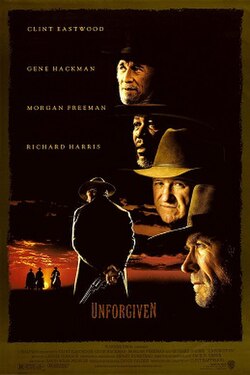
Unforgiven: A Revisionist Masterpiece of the Western Genre
Unforgiven won four Academy Awards, including Best Picture and Best Director.
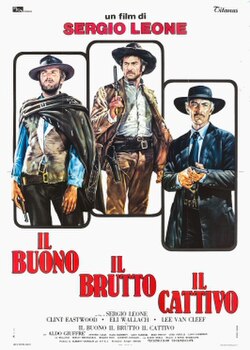
The Good, the Bad and the Ugly (Italian: Il buono, il brutto, il cattivo) is a seminal 1966 epic Western directed by Sergio Leone. Widely considered the pinnacle of the Spaghetti Western genre, the film serves as the final installment of the thematic 'Dollars Trilogy,' following A Fistful of Dollars (1964) and For a Few Dollars More (1965). Set during the American Civil War, the narrative follows three gunslingers—the Good (Clint Eastwood), the Bad (Lee Van Cleef), and the Ugly (Eli Wallach)—as they navigate shifting alliances in a ruthless pursuit of buried Confederate gold.
Leone's directorial approach redefined the Western aesthetic. The film is noted for its juxtaposition of expansive, panoramic landscape shots and extreme, tension-filled close-ups. This visual language is complemented by Ennio Morricone’s iconic score, which utilizes experimental soundscapes and operatic themes to heighten the dramatic intensity of the gunfights. Although the film is set in the American Southwest, the majority of the production took place in Spain, utilizing the Tabernas Desert in Almería and purpose-built sets such as the Sad Hill Cemetery.
Upon its release, the film was a significant commercial success, grossing over $38 million against a modest $1.2 million budget. While initial critical reception was divided due to the genre's departure from traditional Hollywood morality, the film has since undergone extensive re-evaluation. It is now frequently cited as one of the most influential motion pictures in history, praised for its technical mastery, editing by Nino Baragli and Eugenio Alabiso, and its lasting influence on global popular culture, including video games, literature, and subsequent generations of filmmakers.
No, the films are connected thematically rather than through a continuous narrative. Clint Eastwood plays a similar 'Man with No Name' archetype in each, but the characters are distinct.
Aquila 2015, p. 203.
The Good, the Bad & the Ugly (2-Disc Collector's Edition) (DVD). Los Angeles: Metro-Goldwyn-Mayer. 1967.
Santoni, Simona (October 11, 2024). "Renato Casaro, due mostre sull'ultimo uomo che dipinse il cinema" [Renato Casaro, two exhibitions on the last man to paint cinema]. Panorama (in Italian). ISSN 0553-1098. Archived from the original on January 25, 2026. Retrieved January 25, 2026.
Neibaur, James (March 12, 2015). The Clint Eastwood Westerns. Rowman & Littlefield Publishers. p. 31. ISBN 978-1-4422-4504-4. Archived from the original on February 9, 2024. Retrieved March 19, 2023 – via Google Books.
The 1966 box office gross of $38.9 million is equivalent to $386 million in 2025.
"Il Buono, il Brutto e il Cattivo – 1 Edizione" [The Good, the Bad and the Ugly – 1st Edition] (PDF). Cine Censura (in Italian). Centro Sperimentale di Cinematografia. Archived (PDF) from the original on January 21, 2026. Retrieved January 21, 2026.
Hughes 2009, p. 15.
Frayling 2000, p. 217.
Munn 1992, p. 59.
Attributed to multiple sources:
Unforgiven won four Academy Awards, including Best Picture and Best Director.
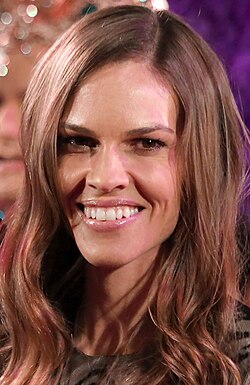
Million Dollar Baby grossed $216,763,646 worldwide during its theatrical run.
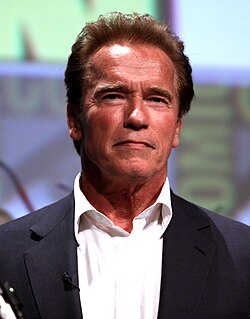
Cry Macho was directed by and starred Clint Eastwood, marking one of his final performances in a feature film.