P
Native American Tribes
3 min
Ponca Tribe of Nebraska
The Ponca Tribe of Nebraska has a total population of 5,334 citizens as of 2023, with 1,923 residing in Nebraska.
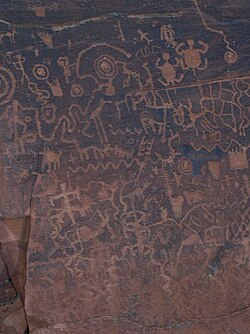
The Sinagua were a pre-Columbian culture that occupied a large area in central Arizona from the Little Colorado River, near Flagstaff, to the Verde River, near Sedona, including the Verde Valley, the area around San Francisco Mountain, and significant portions of the Mogollon Rim country, between approximately 500 and 1425 CE. Since fully developed Sinagua sites emerged in central Arizona around 650 CE, archaeologists believe they migrated from east-central Arizona, possibly emerging from the Mogollon culture.
The name Sinagua was coined in 1939 by archaeologist Harold S. Colton, founder of the Museum of Northern Arizona, from the Spanish words sin meaning "without" and agua meaning "water". This referred to the name originally given by Spanish explorers to the San Francisco Peaks near Flagstaff, the "Sierra Sin Agua". The name reflects the surprise the Spanish felt that such large mountains did not have perennial rivers flowing from them, a common feature in Spain.
Colton also distinguished between two different Sinagua cultural branches. The Northern Sinagua were loosely centered in the highlands around Flagstaff, with Walnut Canyon National Monument, Wupatki National Monument, and Elden Pueblo serving as the best-known publicly accessible sites. The Southern Sinagua inhabited lower elevations across the Verde Valley of central Arizona; Montezuma Castle National Monument, Montezuma Well, Tuzigoot National Monument, Palatki and Honanki Archaeological Sites, and the V Bar V Heritage Site are notable localities open to the public.
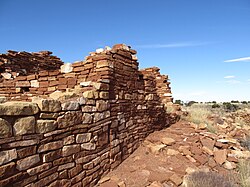
The Sinagua economy combined hunter-gatherer foraging with subsistence agriculture. They hunted game ranging from antelope, bear, and rabbit to smaller animals such as turtles and ducks. Wild plants like amaranth, ricegrass, cactus fruit, beeweed flowers, cattails, sunflowers, hackberry fruit, yucca, wild grapes, walnuts, pine nuts, and acorns provided critical nutritional resources.
Sinagua farmers began cultivating maize in the eighth century. They learned irrigation techniques from their southern Hohokam neighbors and incorporated beans and squash into their cropping systems. The 1064 and 1066 eruptions of Sunset Crater covered the region in volcanic ash, which significantly enriched the soil for farming. Around 700 CE, the Sinagua became active in regional long-distance trade networks extending to the Gulf of California and Mesoamerica, trading local baskets and woven cotton cloth for copper, macaws, marine shells, salt, and rare pigments.
Early Sinagua sites consist largely of large pit houses, similar to those built by the Hohokam people of southern Arizona, alongside wooden surface buildings. Later structures closely mirror Pueblo architecture developed by contemporaneous cultural groups across the southwestern United States.
Alongside ceremonial kivas, Sinagua pueblos featured large community rooms, and some incorporated ballcourts and walled courtyards reminiscent of Hohokam architecture. The last known evidence of Sinagua occupation comes from Montezuma Castle, a limestone cliff dwelling situated by Beaver Creek in the Verde Valley. This 65-room structure was constructed by Sinagua communities between 1100 and 1350 CE.
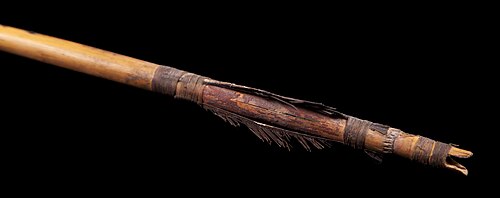
Sinagua plain pottery, known as Alameda Brown Ware, was manufactured using the paddle-and-anvil technique. The clay used was typically grey or brown, tempered with crushed potsherds, and finished with buff, brown, and red slips. Artisans also carved objects using imported red argillate.
Sinagua peoples left the Verde Valley by the early 15th century. Like other pre-Columbian cultures in the Southwest, they abandoned their permanent settlements, though the exact reasons remain a subject of research; resource depletion, severe drought, and conflicts with newly arriving Yavapai groups have all been proposed as contributing factors.
Several contemporary Hopi clans trace their ancestry to immigrants from the Sinagua culture, believing their forebears left the Verde Valley for religious reasons. Pima, Tohono O'odham, Yavapai, and Zuni groups also maintain cultural, linguistic, and historical connections to the Sinagua people.
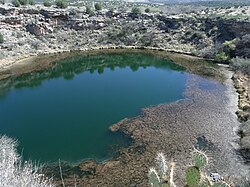
The name comes from the Spanish words 'sin agua', meaning 'without water', given by Spanish explorers because the prominent San Francisco Peaks lacked perennial rivers.
"Sinagua". Logan Museum of Anthropology. Beloit College.
"The Sinagua". Anthropology Laboratories of Northern Arizona University. Retrieved 17 November 2015.
Gibbon 770
Linoff, Lindsay (1998). "The Sinagua People of Montezuma Castle". Mesa Community College. Archived from the original on 12 April 2020. Retrieved 12 April 2020.
Gibbon 771
O'Brien, Melanie (1 April 2015). "Notice of Inventory Completion: U.S. Department of the Interior, National Park Service, Montezuma Castle National Monument, Camp Verde, AZ". Federal Register. 80 (62). National NAGPRA: 17, 477–17, 479. Archived from the original on June 14, 2015. Retrieved 17 November 2015.
The Ponca Tribe of Nebraska has a total population of 5,334 citizens as of 2023, with 1,923 residing in Nebraska.
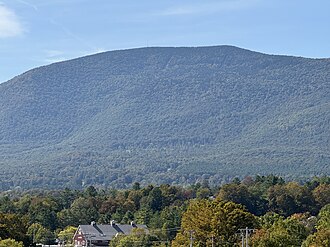
Mount Equinox is the highest peak in the Taconic Range.
Founded in 1926 as the South Island Motor Union (SIMU).