Geography of Vermont
3 min
The Taconic Range's Highest Peak: A Profile of Mount Equinox
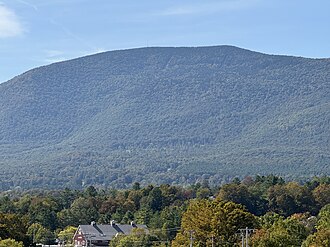
Mount Equinox is the highest peak in the Taconic Range.
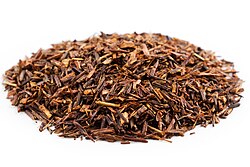
Rooibos (scientific name: Aspalathus linearis) is a broom-like member of the plant family Fabaceae native to South Africa's mountainous Fynbos biome. The needle-like leaves of the plant are harvested and processed to produce a popular caffeine-free herbal infusion known as rooibos tea, red bush tea, or red tea. Consumed for generations in Southern Africa, rooibos gained significant international popularity beginning in the early 2000s due to its distinct earthy aroma and flavour profile.
Rooibos belongs to the legume family, Fabaceae, and features fine, needle-like leaves and yellow flowers typical of many members of the subfamily Faboideae. Formerly classified under the genus Psoralea, the plant was later placed into the genus Aspalathus following taxonomic revisions by Dahlgren in 1980. The specific epithet linearis was assigned by Nicolaas Laurens Burman in 1759, describing the plant's linear growing structure and narrow leaf morphology.
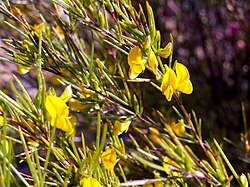
As an endemic plant of the Cape Provinces, rooibos thrives in nutrient-poor, acidic sandy soils under a Mediterranean climate characterized by winter rainfall and hot, dry summers. Like many legumes, it forms symbiotic relationships with nitrogen-fixing soil bacteria, allowing it to survive in harsh, nutrient-deficient environments.
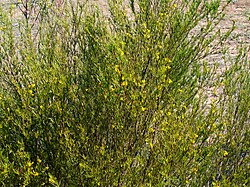
Rooibos is farmed almost exclusively within a restricted 60,000-hectare area in the Cederberg region, located roughly 249 kilometres north of Cape Town in South Africa's Western Cape province. The industry serves as a vital seasonal employer during the summer harvest.
Traditional processing involves cutting the green branches, bundling them, and bruising or crushing the leaves to initiate oxidation. During this enzymatic oxidation process, the leaves develop their signature reddish-brown colour and rich, sweet, earthy flavour. After oxidation, the tea is sun-dried, cleaned, and sterilized for local and international markets.
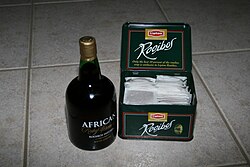
An unoxidized variety known as green rooibos is also produced by halting the oxidation process immediately after harvesting, usually via steam-heating. Green rooibos retains a higher concentration of polyphenols and yields a lighter, malty, and slightly grassy flavour, though its more demanding production method makes it more costly than traditional red rooibos.
Rooibos is naturally free of caffeine and contains very low levels of tannins compared to traditional tea (Camellia sinensis). Fresh leaves contain high amounts of ascorbic acid (vitamin C), while processed leaves and stems feature diverse phenolic compounds, including flavanols, flavones, dihydrochalcones, and unique antioxidants such as nothofagin and aspalathin.
The beverage is typically prepared as an infusion by steeping the dried leaves in boiling water. It is consumed plain or modified with milk, sugar, honey, or lemon, and is also utilized in modern culinary applications such as iced teas, lattes, and espresso-style drinks.
No, rooibos is naturally 100% caffeine-free, making it a popular alternative for individuals looking to avoid stimulants.
"Rooibos Trademark Abandoned". American Herbal Products Association. Archived from the original on 21 December 2014. Retrieved 21 December 2014.
Hawkins, H.-J.; Malgas, R.; Biénabe, E. (April 2011). "Ecotypes of wild rooibos (Aspalathus linearis (Burm. F) Dahlg., Fabaceae) are ecologically distinct". South African Journal of Botany. 77 (2): 360–370. doi:10.1016/j.sajb.2010.09.014. hdl:2263/15615.
Morton, Julia F. (1983). "Rooibos tea (Aspalathus linearis), a caffeineless, low-tannin beverage". Economic Botany. 37 (2): 164–173. Bibcode:1983EcBot..37..164M. doi:10.1007/BF02858780. JSTOR 4254477. S2CID 30957644.
"Threatened Species Programme | SANBI Red List of South African Plants". redlist.sanbi.org. Retrieved 17 January 2026.
Van Putten, JW (2000). Die Geskiedenis van Rooibos. Clanwilliam: JW van Putten. pp. 5–12.
"Aspalathus linearis (Burm.f.) R.Dahlgren". Plants of the World Online. Royal Botanic Gardens, Kew. Retrieved 12 April 2025.
"(Making the Origin Count: Two Coffees)...And a Tea". www.wipo.int. Retrieved 15 December 2021.
Rebelo, A.G.; Mtshali, H.; von Staden, L. (17 April 2005). "Thistle Sugarbush". Red List of South African Plants. version 2020.1. South African National Biodiversity Institute. Retrieved 16 July 2020.
Gorelik, Boris (October 2018). "Rooibos: an ethnographic perspective" (PDF). South African Rooibos Council. Retrieved 12 November 2019.
"Disputing a Name, Developing a Geographical Indication". www.wipo.int. 2018 [2011]. Retrieved 30 March 2023.
Mount Equinox is the highest peak in the Taconic Range.
Founded in 1926 as the South Island Motor Union (SIMU).
The Hungarian water polo system operates on a hierarchical pyramid model with promotion and relegation.