Geography of Vermont
3 min
The Taconic Range's Highest Peak: A Profile of Mount Equinox
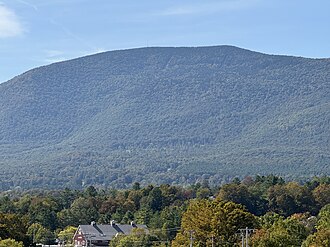
Mount Equinox is the highest peak in the Taconic Range.

In agriculture, a plowshare (US) or ploughshare (UK) is the cutting or leading edge component of a plow. Positioned directly preceding the moldboard, it closely follows the coulter—one or more ground-breaking spikes—during plowing operations. The primary function of the plowshare is to enter the cleft in the earth created by the coulter and begin lifting and turning the soil over.
Traditionally, the plowshare was forged directly by a blacksmith as a hardened blade integrated into the moldboard, forming a unified assembly responsible for both cutting and inverting the earth. In well-tilled terrain, a skilled operator might use the plowshare effectively without needing a preceding coulter. In modern agricultural machinery, both the coulter and the plowshare are manufactured as detachable parts, allowing for quick replacement when worn or broken down from heavy use.
The origins of the plowshare stretch back deep into agricultural history. Triangular-shaped stone plowshares have been discovered at the sites of the Chinese Majiabang culture, dating back to approximately 3500 BC around Lake Tai. Similar artifacts have also been recovered from the nearby Liangzhu and Maqiao archaeological sites from the same period. British archaeologist David R. Harris noted that these early tools indicate intensive cultivation in fixed, likely bunded fields had already been established.
According to the classifications by researchers Mu Yongkang and Song Zhaolin, these triangular plows evolved into various designs, marking a departure from earlier Hemudu and Luojiajiao spades, with the Songze small plow representing an intermediate step in agricultural technology. By the post-Liangzhu period, these advanced plows were successfully paired with draft animals.

Because of its foundational importance to human civilization, food security, and rural life, the plowshare is a frequent charge in European heraldry. It appears on the municipal coats of arms for numerous towns and administrative regions, such as Erding, Tunau, Leuna, Erlbach, Neuler, and even the Archdiocese of Cincinnati.

The plowshare holds an enduring place in cultural metaphor. The famous biblical passage from the Book of Isaiah, "to turn swords into ploughshares," remains a widely used idiom symbolizing the peaceful conversion of military hardware and wartime capabilities into tools for sustaining life and civil society. Conversely, the Book of Joel utilizes the inverse imagery: "Beat your plowshares into swords," representing mobilization for conflict.
In classical antiquity, the plowshare also entered legendary history. During the Battle of Marathon, the ancient Athenians reported that a fierce ally suddenly appeared on their side, slaying numerous Persian soldiers using only a deadly plowshare. After the battle ended and the mysterious figure vanished, an oracle instructed the Athenians to worship this hero under the name Echetlaeus, meaning the hero with the "echetlon" or plowshare.
The plowshare is the sharp, leading edge that cuts horizontally through the soil beneath the surface, while the moldboard is the curved plate directly behind it that lifts, twists, and inverts the cut earth.
Harris (1996), 427–428.
You Archived 2011-07-06 at the Wayback Machine (1999), 1–8.
Lloyd, W. Watkiss (1881). "The Battle of Marathon: 490 B. C." The Journal of Hellenic Studies. 2: 380–395. doi:10.2307/623580. ISSN 0075-4269.
Mount Equinox is the highest peak in the Taconic Range.
Founded in 1926 as the South Island Motor Union (SIMU).
The Hungarian water polo system operates on a hierarchical pyramid model with promotion and relegation.