P
Literature
2 min
Passionate Minds: The Great Enlightenment Love Affair
Passionate Minds was written by David Bodanis and published in 2006.
Plato's Dream (original French title: Songe de Platon) is a short story published in 1756 by the French Enlightenment philosopher and satirist Voltaire. Recognized as one of the earliest examples of modern science fiction, the work utilizes a dream narrative to critique religious dogma and the metaphysical assumptions of the era.
The narrative is framed as a dream attributed to the ancient Greek philosopher Plato. In this vision, a supreme deity known as Demiurgos, or the "eternal geometer," assigns a group of lesser divine beings the task of creating their own worlds. One such being, Demogorgon, takes responsibility for the creation of Earth. Initially, Demogorgon is satisfied with his work, believing he has achieved a level of perfection that would silence any potential critics.
However, the creation is soon met with ridicule from other divine beings, who point to the disproportionate amount of suffering and evil present on the planet. The story culminates in a heated debate among the creators regarding the quality of their respective worlds. The narrative concludes with Demiurgos silencing the group, asserting that only he possesses the capacity to create perfect and immortal things, a claim that Demogorgon challenges, thereby satirizing the theological concept of a perfectly ordered, harmonious universe.
Voltaire wrote Plato's Dream during a period when Enlightenment thinkers were actively re-evaluating the influence of ancient Greek philosophy. While figures like Socrates were often venerated by the philosophes as symbols of rational inquiry, Voltaire maintained a more complex and often ambivalent relationship with the works of Plato. He frequently criticized Plato for what he perceived as "inintelligibility" and convoluted metaphysics, viewing some of his dialogues as sophistry that reinforced religious hierarchies rather than promoting genuine reason.
The story specifically draws inspiration from Plato's Timaeus, a dialogue that explores the origins of the universe. By subverting the Platonic framework, Voltaire challenged the religious and philosophical doctrines that relied on the idea of a divinely ordered, perfect world, using the absurdity of the "lesser superbeings" to highlight the logical inconsistencies he found in contemporary religious thought.
Along with his 1752 novella Micromégas, Plato's Dream is frequently cited by literary historians as a precursor to modern science fiction. By employing a speculative narrative involving extraterrestrial creation and cosmic perspectives, Voltaire moved away from traditional allegories, instead using the genre to explore philosophical questions through the lens of a fictional, non-human reality.
No, the story was written by the 18th-century French philosopher Voltaire. He used the name of the ancient Greek philosopher as a literary device to frame his satirical narrative.
Bourgault, Sophie (2010). "Appeals to Antiquity: Reflections on some French Enlightenment Readings of Socrates and Plato". Lumen: Selected Proceedings from the Canadian Society for Eighteenth-Century Studies / Lumen: travaux choisis de la Société canadienne d'étude du dix-huitième siècle. 29: 43–58. doi:10.7202/1012025ar. ISSN 1209-3696.
Trapp, Michael B. (2007). Socrates from antiquity to the englightenment. Centre for hellenic studies. Aldershot: Ashgate. ISBN 978-0-7546-4124-7.
Voltaire (2007). Philosophical Letters. HackettPublishingCompany. pp. 15–17. ISBN 978-0-87220-882-7.
"Oneiromancy", Wikipedia, 2024-12-23, retrieved 2024-12-31
Bristow, William (2023), Zalta, Edward N.; Nodelman, Uri (eds.), "Enlightenment", The Stanford Encyclopedia of Philosophy (Fall 2023 ed.), Metaphysics Research Lab, Stanford University, retrieved 2024-12-20
Barbera, Joseph (2008-12-01). "Sleep and dreaming in Greek and Roman philosophy". Sleep Medicine. 9 (8): 906–910. doi:10.1016/j.sleep.2007.10.010. ISSN 1389-9457. PMID 19014776.
Sandars, Nancy K., ed. (1977). The epic of Gilgamesh. Penguin classics (Rev. ed. inc. new material ed.). Harmondsworth, Middlesex, Engl: Penguin Books. ISBN 978-0-14-044100-0.
Dalley, Stephanie, ed. (2008). Myths from Mesopotamia: creation, the flood, Gilgamesh, and others. Oxford world's classics (Revised edition, reissued ed.). Oxford: Oxford University Press. ISBN 978-0-19-953836-2.
"Allegory of the Cave". Humanities/Philosophy. Retrieved 2024-12-19.
"Plato's Dream, Voltaire, 1756". websites.umich.edu. Retrieved 2024-12-19.
Passionate Minds was written by David Bodanis and published in 2006.
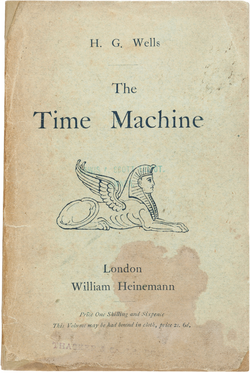
Forward time travel is a proven physical phenomenon caused by time dilation in special and general relativity.

Mount Equinox is the highest peak in the Taconic Range.