Hindu Goddesses
2 min
Mahakali
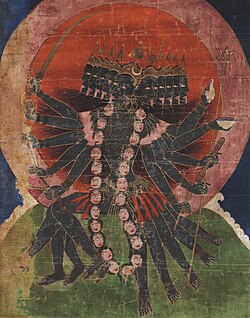
Mahakali is the feminine counterpart to Mahakala, representing the 'Great Time' or the power of destruction.
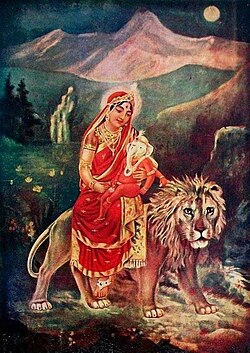
Parvati is one of the most prominent goddesses in Hinduism, revered as the embodiment of power, nourishment, beauty, and divine devotion. As the consort of Shiva, she represents the life-affirming, creative energy that complements his ascetic nature. Together with Lakshmi and Sarasvati, she constitutes the Tridevi, the feminine counterpart to the Trimurti.
The name Parvati is derived from the Sanskrit word parvata, meaning mountain. She is recognized as the daughter of Himavan, the personification of the Himalayas, and his wife, Mena. This association is reflected in her various epithets, such as Shailaja (daughter of the mountains) and Girija. Other names, including Uma and Gauri, highlight her multifaceted nature as both a gentle mother and a fierce protector.
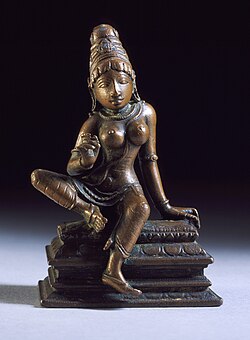
In Hindu mythology, Parvati is considered the reincarnation of Sati, Shiva's first wife. Her birth and subsequent marriage to Shiva are central narratives intended to draw the god out of his deep meditative withdrawal and into the life of a householder. This union is philosophically significant, representing the balance between Purusha (consciousness) and Prakriti (nature/energy). She is the mother of Ganesha and Kartikeya, embodying the ideal of motherhood and domestic harmony.
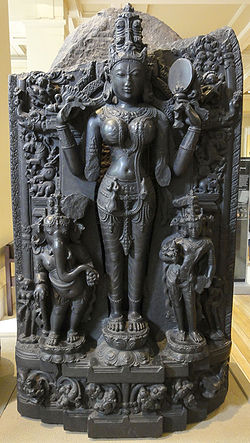
Within the Shakta tradition, Parvati is viewed as a benevolent manifestation of Mahadevi, the Supreme Goddess. She is the source of Shakti, the cosmic energy that animates the universe. Her manifestations are diverse, ranging from the nurturing Gauri to the fierce Durga and Kali, illustrating the spectrum of divine power that encompasses both creation and destruction.

In Hindu theology, Parvati, Durga, and Kali are often treated as different manifestations of the same supreme goddess (Mahadevi). While they have distinct iconographies and mythologies, they are philosophically unified as expressions of the same divine power.
"Meenakshi Devi, the Fish-Eyed Cosmic Mother | Shyamala Peetha Sarvajnapeetha". Retrieved 21 April 2025.
In the Ramayana, the river goddess Ganga is the first daughter and the elder sister of Parvati (Wilkins 2001, p. 294).
James Lochtefeld (2005), "Yoni" in The Illustrated Encyclopedia of Hinduism, Vol. 2: N–Z, pp. 784, Rosen Publishing, ISBN 0-8239-2287-1
Anucasana Parva The Mahabharata, pp 670–672
Helen Jessup (2008), The rock shelter of Peuong Kumnu and Visnu Images on Phnom Kulen, Vol. 2, National University of Singapore Press, ISBN 978-9971694050, pp. 184–192
Michele Stephen (2005), Desire Divine & Demonic: Balinese Mysticism in the Paintings, University of Hawaii Press, ISBN 978-0824828592, pp 119–120, 90
Devotion, mirth mark ‘Hariyali Teej’ The Hindu (10 August 2013)
Sita Narasimhan (2006). Śaivism Under the Imperial Cōl̲as as Revealed Through Their Monuments. Sharada Publishing House. p. 100. ISBN 9788188934324.
S Gupta (2002), Festivals of India, ISBN 978-8124108697, pp 68–71
H.V. Dehejia, Parvati: Goddess of Love, Mapin, ISBN 978-8185822594, pp 11
Mahakali is the feminine counterpart to Mahakala, representing the 'Great Time' or the power of destruction.

Mount Equinox is the highest peak in the Taconic Range.
Founded in 1926 as the South Island Motor Union (SIMU).