Space Exploration
2 min
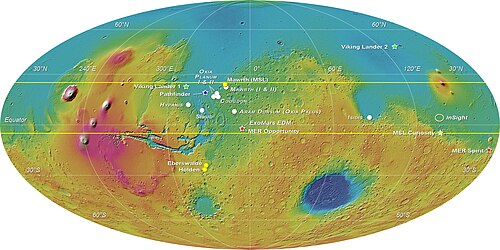
Schiaparelli Entry, Descent, and Landing Demonstrator Module
The Schiaparelli module was launched on 14 March 2016 as part of the ExoMars 2016 mission.
Gravity-1 (Chinese: 引力一号 or YinLi-1) is a solid-propellant expendable medium-lift launch vehicle designed, manufactured, and operated by the Chinese commercial aerospace company Orienspace. Capable of deploying large-scale satellite constellations, the rocket can transport payloads of up to 6.5 tonnes to Low Earth Orbit (LEO) or 4.2 tonnes to Sun-Synchronous Orbit (SSO).

Gravity-1 stands approximately 30 meters tall with a fairing diameter of 4.2 meters. At lift-off, the vehicle weighs 400 tonnes and generates 600 tonnes of thrust. The launch vehicle consists entirely of solid-rocket motors, housing a total of seven solid-propellant motors. The initial thrust is provided by four side-mounted solid rocket boosters (SRBs) ignited on the ground, followed by the sequential air-ignition of three core boosters.
The maiden flight of Gravity-1 took place on January 11, 2024, launched from a specialized sea-launch platform in the Yellow Sea. This flight successfully deployed three Yunyao-1 meteorological satellites built by the Shanghai Academy of Spaceflight Technology as part of an expanding 90-satellite constellation. The mission set multiple records, establishing Gravity-1 as both the world's most powerful solid-fuel carrier rocket and China's most powerful commercial launch vehicle to date.
Utilizing solid propellants allows Gravity-1 to achieve a remarkably rapid turnaround time, requiring only five hours between completing manufacturing operations and final launch execution. This quick response capability makes the vehicle well-suited for responsive space missions and commercial constellation deployment. Orienspace has secured launch contracts for over one hundred satellites following the rocket's successful introduction.
Gravity-1 uses solid propellants exclusively, utilizing a configuration of seven solid rocket motors.
Eastern Space (2024-01-11). "引力一号海上首飞成功! 创全球最大固体运载火箭纪录!" [Gravity-1's maiden sea flight is a success! Setting a new record for the world's largest solid-propellant launch vehicle!]. WeChat (in Chinese). Archived from the original on 2024-01-11. Retrieved 2024-01-11.
Mansfield, Simon (2024-01-12). "China's Gravity 1 sets record for solid rocket fuels in maiden launch". Space Daily. Retrieved 2024-04-29.
Sesnic, Trevor (2024-01-09). "Maiden Flight | Gravity-1". Everyday Astronaut. Retrieved 2024-04-29.
Jones, Andrew (11 January 2024). "Orienspace breaks Chinese commercial launch records with Gravity-1 solid rocket". SpaceNews. Retrieved 11 January 2024.
Gravity-1 rocket explained. SciNews. Retrieved 2024-04-07 – via YouTube.
Wall, Mike (2024-01-11). "China's record-breaking Gravity-1 rocket aces amazing debut launch from ship at sea (video)". Space. Retrieved 2025-10-03.
The Schiaparelli module was launched on 14 March 2016 as part of the ExoMars 2016 mission.
The initiative was originally announced in May 2023 as the Commercial Cargo Transportation Initiative.
Space Epoch is a Beijing-based private aerospace manufacturer founded to develop reusable launch vehicles.