Astronomy
3 min
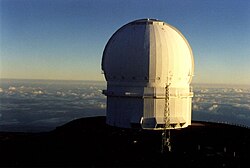
Canada–France–Hawaii Telescope
The Canada–France–Hawaii Telescope features a 3.58-meter optical and infrared primary mirror.
A dwarf nova (plural: novae), also referred to as a U Geminorum variable, represents a specific class of cataclysmic variable star systems. These systems are close binaries consisting of a primary white dwarf star that accretes matter from a less massive companion star, typically a main-sequence star. While sharing a name and certain visual characteristics with classical novae, dwarf novae are significantly dimmer and exhibit outbursts much more frequently.

The first recognized example of this phenomenon was U Geminorum, discovered in 1855. However, the underlying physical mechanism remained unexplained until 1974, when astronomer Brian Warner demonstrated that outbursts stem from a sudden increase in the luminosity of the accretion disk rather than thermonuclear explosions on the stellar surface.
Unlike classical novae, which are powered by runaway thermonuclear fusion and the detonation of hydrogen accumulated on the white dwarf's surface, dwarf novae are driven by thermal-viscous instabilities within the accretion disk itself. Gas spiraling inward from the donor star accumulates in the disk until it reaches a critical temperature threshold. This triggers a sudden shift in viscosity, accelerating mass flow through the disk, heating the entire structure, and causing a dramatic rise in overall brightness. Once the excess material drains onto the white dwarf, the disk cools, returning to its quiescent state.
Astronomers categorize dwarf novae into three primary subtypes based on their light curve characteristics and outburst behavior:


While both involve white dwarfs in binary systems, classical novae are driven by runaway thermonuclear fusion of hydrogen on the white dwarf's surface, resulting in rare, highly luminous explosions. Dwarf novae are powered by thermal instabilities within the accretion disk, producing dimmer outbursts that repeat much more frequently, ranging from days to decades.
Samus, N.N.; Durlevich, O.V. (12 February 2009). "GCVS Variability Types and Distribution Statistics of Designated Variable Stars According to their Types of Variability". Retrieved 8 February 2013.
Warner, Brian (July 1974). "Observations of Rapid Blue Variables – XIV: Z C HAMAELEONTIS". Monthly Notices of the Royal Astronomical Society. 168 (1): 235–247. doi:10.1093/mnras/168.1.235.
Simonsen, Mike (ed.). "Introduction to CVs". mindspring.com. Cataclysmic Variable Network. Archived from the original on 26 February 2008. Retrieved 17 April 2006.
"Calibrating Dwarf Novae". Sky & Telescope. September 2003. p. 20.
Darling, David (1 February 2007). "U Geminorum star". Daviddarling.info. Retrieved 9 February 2013.
Gao, Weihong; Li, Zongyun; Wu, Xiaoan; Zhang, Zhousheng; Li, Yulan (1999). "Superhumps in a Peculiar SU Ursae Majoris-Type Dwarf Nova, ER Ursae Majoris". The Astrophysical Journal. 527 (1): L55–L58. arXiv:astro-ph/9910558. Bibcode:1999ApJ...527L..55G. doi:10.1086/312398. PMID 10566998.
Darling, David (1 February 2007). "SU Ursae Majoris star". Daviddarling.info. Retrieved 9 February 2013.
Stehle, R.; King, A.; Rudge, C. (May 2001). "The standstill luminosity in Z Cam systems". Monthly Notices of the Royal Astronomical Society. 323 (3): 584–586. arXiv:astro-ph/0012379. Bibcode:2001MNRAS.323..584S. doi:10.1046/j.1365-8711.2001.04223.x. S2CID 14478251.
Osaki, Yoji (January 1996). "Dwarf-Nova Outbursts". Publications of the Astronomical Society of the Pacific. 108: 39. Bibcode:1996PASP..108...39O. doi:10.1086/133689.
The Canada–France–Hawaii Telescope features a 3.58-meter optical and infrared primary mirror.
The Texas Supernova Search was led by astronomer Robert Quimby.
NGC 5000 is a barred spiral galaxy situated in the constellation Coma Berenices.